Image

Instituto de Productos Naturales y Agrobiología
Piscidins are cationic α-helical antimicrobial peptides (AMPs) that constitute a key component of the innate immune defense of teleost fish, yet the relationship between their genomic organization, structural properties, and functional specialization remains incompletely understood. In this study, six piscidin peptides from Epinephelus akaara, Seriola dumerili, Thunnus maccoyii, Argyrosomus regius, Dicentrarchus labrax, and Epinephelus coioides were characterized through an integrated sequence-to-function approach combining comparative genomics, structural modeling, physicochemical analysis, and in vitro validation, with the aim of identifying candidates with potential for biomedical and biotechnological applications.
All genes studied exhibited the conserved four-exon, three-intron architecture characteristic of teleost piscidins. Structural modeling and circular dichroism confirmed α-helical conformations under membrane-mimetic conditions, despite measurable differences in hydrophobicity, charge distribution, and predicted membrane insertion parameters. Antimicrobial assays revealed distinct functional profiles: Sd_FI25 and Epinecidin_1 displayed broad antibacterial activity against Gram-positive and Gram-negative pathogens, whereas Dl_FI22 showed selective activity with reduced temporal persistence associated with lower peptide stability. Ea_FF25 exhibited comparatively weak antibacterial potency. Antibiofilm activity varied among peptides and did not uniformly parallel planktonic MIC values. Computational predictions further suggested antiviral and antitumoral potential for several sequences, extending their prospective relevance beyond classical antibacterial roles.
Conserved genomic architecture and α-helical structure coexist with pronounced functional diversification among teleost piscidins. These findings demonstrate that integrating structural prediction with experimental validation is an effective strategy for identifying fish-derived innate immune peptides as candidates for biomedical applications.
Asensio-Calavia, Patricia; González-Acosta, Sergio; Cavaco, Marco; Neves, Vera; Rodríguez-Borges, Víctor Manuel; Morales-delaNuez, Antonio; Castanho, Miguel A.R.B.; Pérez de la Lastra, José Manuel.
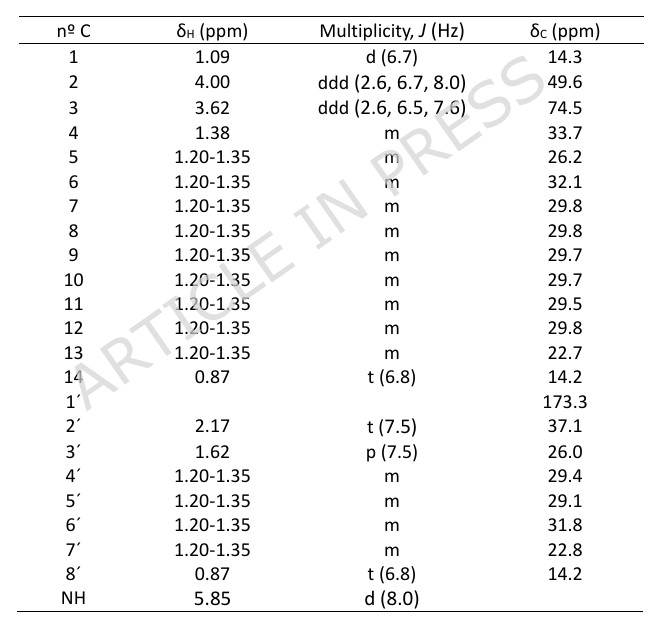
Pycnoporus sanguineus is a basidiomycete fungus widely distributed in tropical and subtropical regions and recognized for its intense red–orange pigmentation and pronounced ligninolytic activity. The lipid composition of this fungus remains poorly explored, and atypical sphingolipids have not previously been reported in this genus. In this study, we describe the isolation and structural characterization of pseudoceramide A, an atypical 1-deoxyceramide obtained from liquid cultures of P. sanguineus. A scaled-up fermentation was developed in combination with stable 13C isotope-labeling experiments to investigate its biosynthetic origin. The fungal biomass was harvested and subjected to chromatographic separation, yielding pseudoceramide A as a pure compound. Structural elucidation and absolute configuration determination were achieved using NMR spectroscopy. Comparative analysis of labeling experiments employing [1-13C] acetate and [2-13C] acetate revealed an alternating 13C incorporation pattern along the carbon backbone, supporting a singular biosynthetic pathway derived from dodecanoyl-CoA, octanoyl-CoA and alanine. These findings uncover a previously undescribed route for ceramide biosynthesis in fungi. The identification of pseudoceramide A represents the first report of a 1-deoxyceramide from the genus Pycnoporus and broadens current knowledge of fungal sphingolipid diversity. This newly characterized compound constitutes a promising target for future studies addressing its biological properties and potential biotechnological applications.
Manzano, Karmen; Nocchi, Nathália; González-Solís, Rosalba; Mendoza, Gillermo; Díaz-Marrero, Ana Raquel; Trigos, Ángel; Fernández, José J.
Background
Cellular redox regulation is increasingly recognised as a spatially organised network in which oxidant production, thiol buffering, and selective signalling operate within compartment-specific microdomains rather than as uniform cellular processes. However, peptide-mediated mechanisms that actively define these local redox environments have not previously been integrated into a unified conceptual framework.
Objective
This review introduces the concept of peptide redox networks, defined as peptide or protein systems whose local abundance, oxidation state, or proteolytic processing directly determines the amplitude, spatial confinement, or propagation of redox signalling within specific cellular microdomains. We evaluate the evidence supporting this framework and discuss its implications for mechanistic research and clinical translation.
Main Content
We synthesise current knowledge on glutathione, histidine-containing dipeptides, mitochondria-targeted peptides, and mitochondrial-derived peptides as complementary regulators of cellular redox homeostasis. Particular emphasis is placed on compartment-specific redox set points, NADPH-dependent buffering, ferroptosis vulnerability, mitochondrial quality control, and regulated thiol signalling. We further examine recent advances in redox proteomics, isotope tracing, and proteoform-aware analytical strategies, highlighting methodological challenges that influence data interpretation. Based on these considerations, we propose operational criteria for defining peptide redox network components, establish minimum reporting recommendations to improve reproducibility, and identify experimental approaches capable of distinguishing adaptive redox regulation from irreversible oxidative dysfunction.
Pérez de la Lastra, José Manuel; Curieses Andrés, Celia María; Bustamante Munguira, Elena; Andrés Juan, Celia; Pérez-Lebeña, Eduardo.
Biological invasions are a major threat to global biodiversity, with a particular strong impact on oceanic islands and their unique and fragile biotas. However, the complexity of the processes underlying invasions has prevented the identification of general patterns explaining why some plant species successfully establish and spread beyond their native ranges. Here, we investigate Darwin's naturalization conundrum in the most species-rich angiosperm family of the Canary Islands, considering two invasion stages at the archipelago and island levels.
Arjona, Yurena; Jay-García, Louis S.; Reyes-Betancort, J. Alfredo; Morente-López, Javier; Salas-Pascual, Marcos; Naranjo-Cigala, Agustín; Sicilia-Pasos, Guillermo; Padrón-Mederos, Miguel A.; Orihuela-Rivero, Raúl; González-Montelongo, Rafaela; Arteaga, Jorge; Jonker, Frank; Patiño, Jairo.
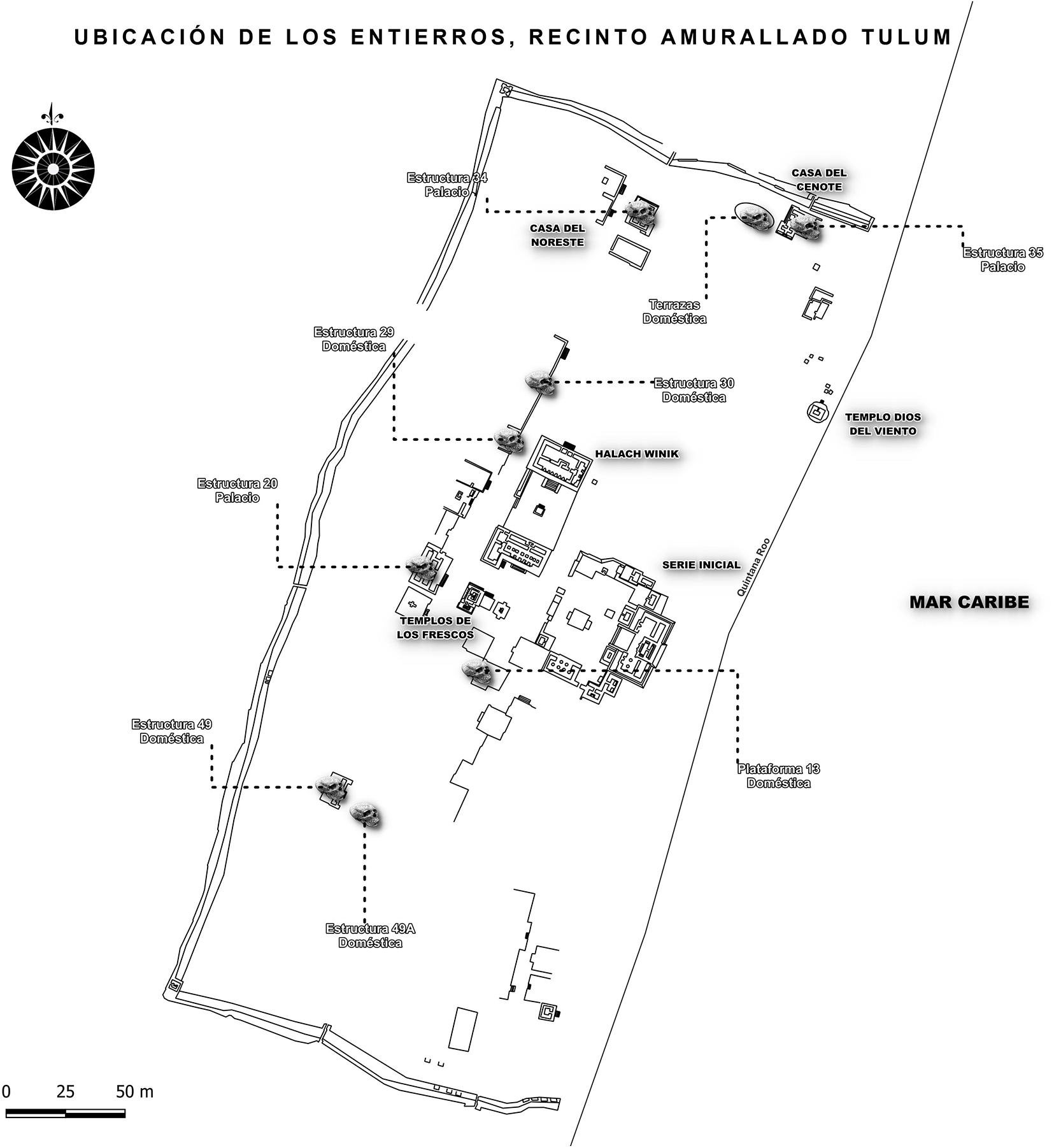
Este estudio ofrece una visión integral sobre la organización social de Tulum durante el Posclásico tardío (1200-1550 dC), destacando cómo los alimentos actuaron como un medio central para negociar poder, estatus y cohesión social. Aunque las élites tenían acceso preferencial a bienes exclusivos, la estructura social heterárquica favoreció una distribución equitativa de recursos, promoviendo la cooperación entre los diferentes niveles de élites que fueron enterradas dentro de la ciudad amurallada de Tulum, sin un control absoluto de los medios de producción. La dieta, basada principalmente en el maíz y complementada con recursos marinos, provocó deficiencias nutricionales significativas, como anemia y enfermedades relacionadas con la falta de vitamina C y hierro. No obstante, estas afecciones no estuvieron ligadas a marcadas disparidades sociales, reflejando un sistema tendencialmente equitativo. Este modelo de organización social inclusiva y cooperativa permitió garantizar estabilidad y prosperidad, a pesar de las distinciones en el acceso a bienes simbólicos. En conjunto, los hallazgos subrayan la importancia de las relaciones sociales y económicas flexibles para mantener la cohesión y resiliencia en contextos de alta densidad poblacional y estrés ambiental.
Uccheddu, Giulia; Ortega-Muñoz, Allan.
In this work, we report the synthesis and structural characterization of a novel organometallic bipyridine-based atropisomer featuring two (S)-BINOL-derived units, each functionalized with a ferrocene moiety and linked by a 4,4′-disubstituted 2,2′-bipyridine bridge. Although the molecule appears symmetric, single-crystal X-ray diffraction establishes its axial chirality, as demonstrated by Flack x = −0.020(14) and Hooft x = 0.013(18) parameters. The bipyridine core, sterically hindered by the bulky ferrocenyl groups, imposes a rigid atropisomeric structure. To better understand this behavior, a new Cu(II) complex is presented to examine how peripheral substitution affects the accessibility and coordination capacity of the bipyridine core; these factors ultimately dictate the solid-state atropisomerism and rigidity of the resulting multinuclear architecture.
Humberto A. Rodríguez, Daniel A. Cruz, Victor Lavin, Juan I. Padrón, Pablo Lorenzo-Luis
Polyphenols often oscillate between antioxidant and pro-oxidant behaviours depending on structural motifs and context, yet the field still relies heavily on test-tube antioxidant assays that poorly predict cellular and clinical outcomes. This review (2015-2025) integrates chemistry, enzymology, and human data to frame polyphenols as modulators of redox signalling rather than mere radical scavengers. We first formalize the catechol/o-quinone-hydroquinone/p-quinone cycle and the role of NQO1 and Keap1/NRF2 thresholds. We then examine bioavailability, conjugation, and microbiota-derived metabolites (metabotypes), highlighting when the “active” species is a conjugate or a microbial derivative. We discuss safety through quinone speciation and adduct chemistry, and connect food processing (e.g., PPO-driven browning) with shifts in quinone pools. Contextual “levers” (pH, O2, Fe/Cu, oxidases) can flip antioxidant to pro-oxidant outputs, sometimes beneficial via hormesis and redox preconditioning. In humans, randomised trials and prospective cohorts point in a broadly consistent direction, although primary composite endpoints have often proved null, and observational associations should not be read as equivalent to trial evidence. Heterogeneous results across studies are largely explained by dose, adherence, metabotypes, matrix, and endpoint selection. We propose a practical dose-response framework and a reporting checklist to improve interpretation and translation. Recasting polyphenols as tuneable redox-signalling agents clarifies apparent contradictions across models and suggests precision-nutrition strategies (metabotype-aware) and food design approaches (PPO and quinone speciation) with potential in healthy ageing, muscle, and brain.
Pérez de la Lastra, José Manuel; Curieses Andrés, Celia María; Bustamante Munguira, Elena; Andrés Juan, Celia; Pérez-Lebeña, Eduardo.
This study investigates occlusal microwear texture patterns of two sequential bioarchaeological populations from sites in western and northern India, each representing a different phase of the same culture: Juna Khatiya (Early Harappan, n = 12) and Rakhigarhi (Mature Harappan, n = 10). These populations, spanning the interval between approximately 3200 BCE and 1900 BCE, were both agro-pastoral, but showed intensified urbanization in the Mature Harappan phase, with concomitant increases craftsmanship and trade. It has been reported that rural peoples in India today consume less processed, more mechanically challenging foods than those living in cities, which has led to the hypothesis that dental microwear may be a useful proxy for tracking settlement pattern in bioarchaeological populations in South Asia. While lower microwear texture complexity was predicted to follow urbanization, recent analysis of two South Indian bioarchaeological populations actually showed the more rural sample to have lower microwear complexity (contra expectation). Here we reevaluate urbanization as a possible driver of microwear texture pattern for agricultural populations in India using two other well-studied populations in different parts of the country. Results indicate that in this case, as predicted, the more urbanized population did have lower microwear texture complexity. This suggests that in some cases, dental microwear texture may be useful as a measure of urbanization but also supports the notion that other factors play an important role in microwear patterning.
Yhome, Ruokuonuo Rose; Rajesh S.V.; Rai, Niraj; Shinde, Vasant; Abhayan G. S.; Conesa, Francesc C.; García-Granero, Juan José; Bhandari, Subhash; Tilva, Parv Prakash; Ungar, Peter S.
Nuclear factor erythroid 2-related factor 2 (NRF2) orchestrates antioxidant defence, electrophile detoxification, and stress recovery across tissues. This paper frames chronic disease vulnerability through the lens of NRF2 insufficiency, defined as reduced functional output of the antioxidant response element programme. We describe the mechanisms that blunt NRF2 signalling, including genetic variation in NFE2L2 and Keap1, epigenetic repression, post-translational degradation routes, and cumulative exposome pressures. Downstream consequences include impaired glutathione-centred buffering, mitochondrial dysfunction, proteostasis failure, inflammatory amplification, and heightened susceptibility to regulated cell death. Using an organ-by-endotype approach, we map recurring patterns across lung, liver, and metabolic tissues, cardiovascular and renal systems, brain, and barrier interfaces that shape systemic ageing phenotypes. Practical biomarkers are reviewed alongside lifestyle and exposome modification strategies, nutritional and nutraceutical approaches, and pharmacological interventions. Preclinical and human evidence for outcome improvement with NRF2 restoration is evaluated, and a risk-management framework addressing boundary conditions such as cancer progression and therapy resistance is proposed. We close with a research agenda prioritising causal study designs, reproducible scoring, and clinically meaningful endpoints to guide precision modulation of NRF2 in chronic disease.
Pérez de la Lastra, José Manuel; Curieses Andrés, Celia María; Bustamante Munguira, Elena; Andrés Juan, Celia; Pérez-Lebeña, Eduardo.
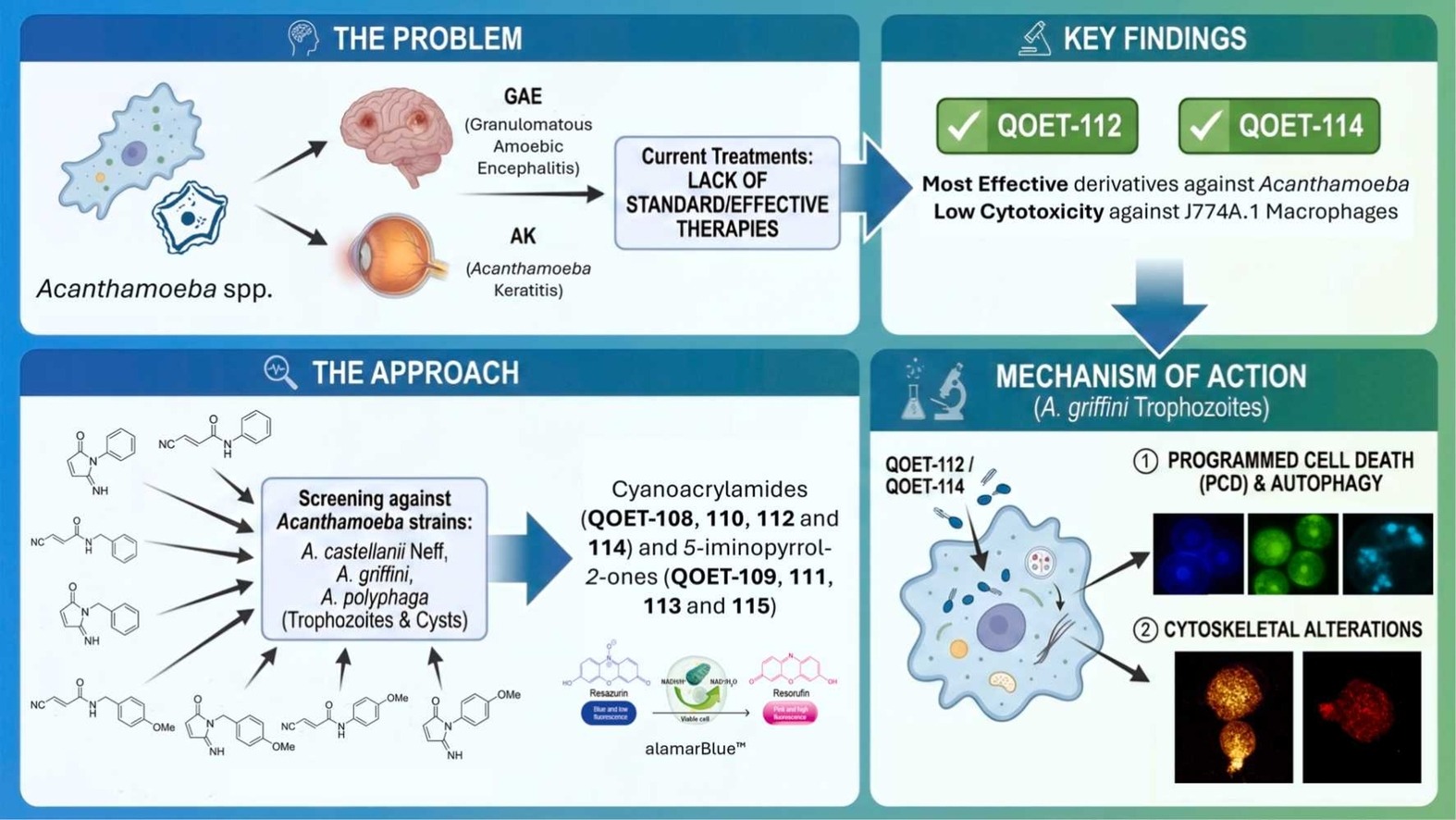
Acanthamoeba spp. are ubiquitous protozoa and the causative agents of severe human infections, including granulomatous amoebic encephalitis (GAE) and Acanthamoeba keratitis (AK). The lack of standardised and fully effective treatments highlights the urgent need for novel therapeutic agents. In this study, we evaluated the in vitro amoebicidal activity of 8 cyanoacrylamide derivatives (QOET) against three different strains of Acanthamoeba: A. castellanii Neff, A. griffini and A. polyphaga. Among the tested compounds, QOET-112 and 114 displayed the lowest IC50 values against both the trophozoite and cyst stages compared to the other derivatives. Furthermore, these compounds demonstrated low cytotoxicity against the murine macrophage cell line J774A.1. Analysis of the mode of action evidenced that both cyanoacrylamides triggered programmed cell death (PCD) and autophagy in A. griffini trophozoites. Additionally, these compounds induced severe cytoskeletal alterations, specifically characterised by the disorganisation and disruption of the actin and tubulin networks.
Rodríguez-Expósito, Rubén L.; Delgado-Hernández, Samuel; Sifaoui, Ines; Reyes-Batlle, María; Tejedor, David; Piñero, José E.; Lorenzo-Morales, Jacob